Showing posts with label Negros Occidental Towns and Cities. Show all posts

Wednesday, December 9, 2009

Roadtripping: Ma-ao, Bago City


Roadtripping to Ma-ao, Bago City, or just about any city or town in Negros Occidental is a fun way to explore the island.

One day, I decided, rather on an impulse and in response to a small emergency, to drive some 40 kilometers from Bacolod City to the next city down South, up to one of its popular barangay, Ma-ao. Further up eastward is Pader, an adjacent barangay where my three girls -- Janice, Jo-an, and Joylyn -- and the rest of their family of four other siblings and their mother reside.

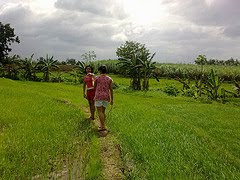
They showed us a vast playground of acres and acres of breezy rice and sugarcane fields, dotted with bamboo clumps, and an assortment of trees.

The Ma-ao Creek is vital to their survival. Along its banks are spots of golden earth they call "tae sang bulawan" or excrement of gold. This is where the clearest water spring from and you can dig a well from which to draw drinking water. However, because the creek also serves as the community's wash area and outhouse, drinking water is preferably fetched from the tap a few distance away at PhP2.00 per container.

A few hundred meters ahead is the children's favorite bamboo playground, a lofty perch accessible by bamboo ladder leading to a bed of dry bamboo leaves and twigs where the children spend warm afternoons dreaming of a better life someday.

But then again, what could be better than clean country air, green landscapes, simple living, exotic fruits and pretty flowers in this little paradise in Ma-ao, Negros Occidental?

Thursday, November 26, 2009

The Ruins in Talisay City, Negros Occidental

The Ruins of Talisay is now what remains of the magnificent 903 square meter Italianate architecture with neo-Romanesque columns. The Ruins (before it was ruined) closely resemble New York's Carnegie Hall.

The mansion, built in the middle of a sprawling sugarcane plantation, was the largest residential structure built during its time. It is home to sugar baron Don Mariano Ledesma Lacson and his Portuguese wife, Maria Braga in the early 1900's.

Maria's father, a ship captain, brought with him the finest furniture, chinawares, and other decorative pieces from all over Europe and Asia. An imported, four-tiered fountain still adorns the Ruins' grounds to this day.

During the World War II, the United States Armed Forces in the Far East (USAFFE) burned the mansion to ruins to thwart Japanese invasion of the mansion with a view to making it as their headquarters. The fire lasted for two days until it finally brought down the roof and the two-inch thick wooden floors.

The main structure still stands to this day, thanks to one of Mariano's son's close supervision of strictly following the grade A mixture of the cement.

With the roof and wooden flooring all gone, it looks up into the open heaven, its grand staircase that was long stripped of its wooden covering seemingly leading to an imaginary second floor where you can almost hear soft elegant music reminiscent of the grand parties the mansion used to hold. And the ghosts of the past seem to be almost visible as they gracefully float in the silver screen of reconstructed memories (never mind that ghostly image in the digitally altered photograph, it's just me terribly frightened not by the thought of seeing the ghosts of christmas past but by the sheer height and nothingness beyond those stairs -- it's supposed to be off limits!).

Having an excellent view of the Talisay sunset, the Ruins is a picture-perfect backdrop for wedding pictorials and other theme pictorials. The historic mansion has a picnic grove a few meters away.

The Ruins is just some 15 minutes' drive from Bacolod City and by private transport. Public transport is a bumpy tricycle ride from Talisay highway and amid vast acres of sugarcane fields.

Another less turbulent (and perhaps safer) route is via Barangay Bata through Bangga Rose Lawns (memorial park), passing through Goldcrest Subdivision.

Conspicuous signs and festive flags have been posted at both routes that lead the way to the Ruins of Talisay City, Negros Occidental.


Saturday, November 7, 2009

Negros Occidental: The Sugar Bowl of the Philippines

Negros Occidental, also known as the Sugar Bowl of the Philippines, is the country's top sugar producer.


This is a friend's photo of the sugar mill where he works. He explained to me the many types of sugar being produced, aside from the familiar table sugar that's either white or brown, and the muscovado.

I've made an extensive research on sugar, the article appears on Follow Me magazine. And until now, I'm not paid for it, nor was I invited during the launching of the magazine. I wrote at least three articles there. Hmmm....


I forgot the magazine article title, and I wasn't SEO oriented in my writing before. Maybe I should just have blogged in the first place my article on Negros Occidental: The Sugar Bowl of the Philippines.

Sunday, October 25, 2009

Adobo Festival 2009 at Balay Negrense, Silay City

It's going to be another Adobo Festival at Balay Negrense in Silay City on November 5, 2009. This day also marks Negros' independence from Spanish rule in 1898.

History tells us that the revolution led by Aniceto Lacson and Nicolas Golez coming from the north of Bacolod City (Silay City), and Juan Araneta from the south (Bago City), won in an overwhelming victory over the Spaniards.

Thus the celebration capitals of Negros Day are in Silay and Bago Cities.

The Balay Negrense Museum in Silay will again hold it's annual celebration with a cooking contest for its Adobo Festival. In connection with this, there will be a kitchen art exhibit by various Negrense artists.

Everybody is welcome to join the celebration.

Saturday, October 3, 2009

Talisay City

So-called because of the abundance of the talisay trees a shade tree with large leaves spreading out in tiered branches.

It is about 15 minutes' ride by public transport from Bacolod City, and 5-10 minutes' drive depending on how fast you drive.

It celebrates its Minuluan Festival every September 10 when juicy rambutan and the famous Concepcion lanzones are in season. When the harvest is especially overabundant, the people of Brgy. Concepcion hold a Lanzones Festival where you can eat all the lanzones that you can for only a little over PhP100.

Monday, September 21, 2009

Silay City

The second city up north of Bacolod City, it is also known as the Paris of Negros because of its unique old world charm. Its well-preserved centuries old ancestral homes and antiquated buildings are reminiscent of the opulence of the hacienderos of long ago.

Famous also for its yummy delicacies, it is about 30 minutes from Bacolod by public transport and about 15 minutes' drive by private vehicle.
Related Posts with Thumbnails